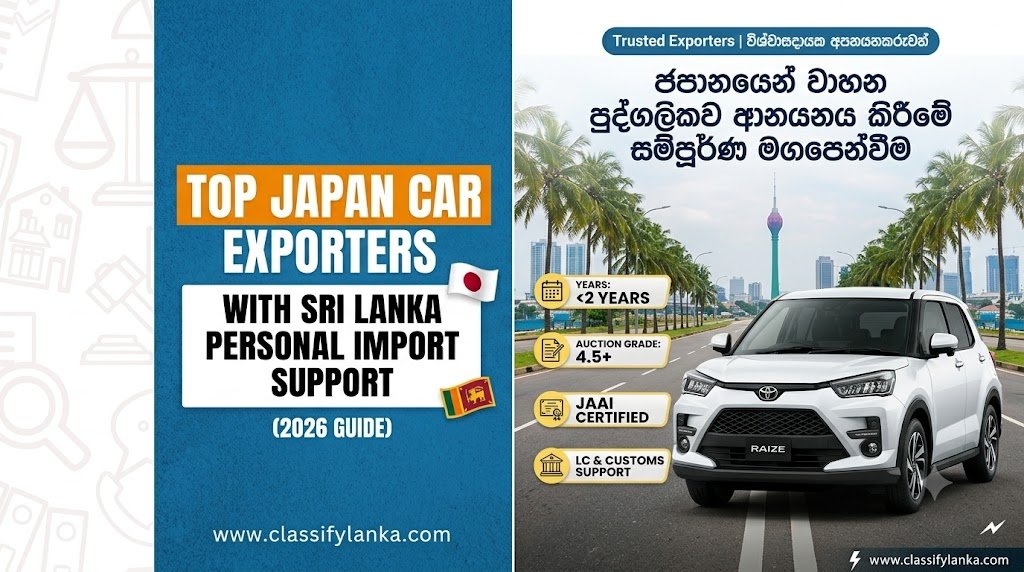
Importing a vehicle to Sri Lanka directly from Japan can save you millions of rupees compared to purchasing through local dealerships, but only if you possess the requisite knowledge to navigate the logistical labyrinth. Most Japanese exporters are structurally engineered for bulk dealers, not individual consumers. Sending substantial capital across the globe and subsequently attempting to decipher Sri Lanka Customs independently is a formidable nightmare for uninitiated first-timers. A singular misstep can result in catastrophic penalty duties or outright confiscation at the port.
This comprehensive guide delineates the top Japan car exporter with personal import support Sri Lanka, prioritizing entities that actually provide granular hand-holding for private buyers. We will illuminate the pathways to ensure your vehicle seamlessly circumvents customs hurdles without precipitating surprise financial hemorrhages.
Why Private Buyers in Sri Lanka Need Specialized Export Support
The procedural matrix for importing automobiles into the island nation is uniquely complex compared to other global jurisdictions. Standard volume exporters operate on a simplistic paradigm: they load the chassis onto a RoRo (Roll-on/Roll-off) vessel destined for Hambantota or Colombo, disburse the Bill of Lading, and effectively dissolve their involvement. You require a specialized intermediary because the local regulatory apparatus is notoriously unforgiving.
Consider the Letter of Credit (LC) process. Sri Lankan banking institutions operate under stringent foreign exchange regulations mandated by the Central Bank. Your exporter must possess the exactitude to format proforma invoices flawlessly for LCs; a mere typographical anomaly can precipitate weeks of bureaucratic gridlock.
Furthermore, the island enforces draconian age restrictions and frequent tax adjustments, including the latest statutory adjustments under the SSCL Amendment Act, on vehicular imports. Passenger cars are strictly capped at two years from their date of manufacture. Conversely, dual-purpose vehicles or commercial vans maintain a slightly wider aperture of three to four years. Procuring an automobile that marginally eclipses these chronological parameters guarantees seizure by customs authorities upon arrival. Consequently, identifying competent Japanese car exporters for private buyers in Sri Lanka is not merely a matter of convenience it is a mandatory prerequisite for preserving your capital and sanity.
Must-Have Services from a Japanese Vehicle Exporter for Sri Lanka
Before remitting a solitary Rupee across the Pacific, you must rigorously verify that your chosen exporter provisions three non-negotiable operational pillars. Foremost is the coordination of the pre-shipment evaluation. A seaworthiness certificate issued by the Japan Auto Appraisal Institute (JAAI) is an inflexible statutory requirement dictated by Sri Lankan Customs. Vehicles arriving without this credential face punitive taxation or immediate deportation.
Secondly, demand the original auction sheets. Disregard paraphrased Word documents or sanitized digital summaries. You require the authentic, unadulterated Japanese auction sheet accompanied by an English translation to meticulously verify true mileage, structural integrity, and accident history.
Finally, evaluate their local clearing support infrastructure. Does the exporter maintain a strategic alliance with a recommended clearing agent in Colombo or Hambantota? Extracting a vehicle from port authority jurisdiction demands specialized localized knowledge to expedite duty payments and circumvent exorbitant demurrages.
Top 5 Japanese Used Vehicle Exporters for Individual Buyers in Sri Lanka
Evaluating the vast ocean of export entities necessitates a paradigm shift. We must focus intrinsically on trust, transparent communication, and hyper-specific market knowledge rather than myopically chasing the absolute lowest CIF (Cost, Insurance, and Freight) valuation. The following roster evaluates the premier operators equipped to handle the nuances of the Sri Lankan market.
1. SAT Japan (The Premium Full-Service Option)
SAT Japan operates with a robust global infrastructure, positioning itself as a bastion of reliability. This entity is particularly advantageous for discerning buyers seeking high-caliber hybrid stock, such as the ubiquitous Toyota Raize or the Honda Vezel. Their operational methodology prioritizes exhaustive condition reporting over sheer volume.
- Pros: Furnishes comprehensive, high-definition inspection videos. Integrates JUMVEA Safe Trade (JUST) payment protection for absolute financial security.
- Cons: Commands a premium pricing architecture. It may prove cost-prohibitive for consumers adhering to a stringent, inflexible budget.
2. SBT Japan (The Global Giant)
As a veritable behemoth in the consumer export ecosystem, SBT Japan commands an imposing market share. Their logistical tentacles reach every major port, making them a highly visible and established entity.
- Pros: Maintains a colossal, continuously updated inventory. Features a highly intuitive, easy-to-navigate digital interface and possesses deep familiarity with standard Sri Lankan maritime shipping routes.
- Cons: Customer service tends to be highly transactional and compartmentalized. If you encounter convoluted LC paperwork friction with your local Sri Lankan bank, they may lack the personalized patience required to untangle the bureaucratic knot.
3. Be Forward (The Budget Platform)
Be Forward has carved a dominant niche by aggressively optimizing for pricing and unprecedented volume. They act as the quintessential supermarket of the Japanese used automotive industry.
- Pros: Consistently offers the most competitive CIF pricing spectrum. Boasts a remarkably wide variety of budget-friendly passenger vehicles.
- Cons: Operates on a highly DIY (Do-It-Yourself) methodology. You are functionally autonomous regarding verifying JAAI readiness and navigating complex local customs compliance, making it precarious for first-time private buyers.
4. Autocom Japan (The Auction Specialist)
Autocom Japan caters to a more analytical demographic: buyers who prefer the granular control of bidding directly on Japanese auction platforms rather than selecting from pre-purchased, ready-stock inventories.
- Pros: Provides highly transparent, unfiltered auction data. Features a robust, real-time proprietary bidding architecture.
- Cons: The bidding mechanism necessitates a formidable learning curve. It requires significant time investment to decipher auction dynamics and win competitive bids against seasoned dealers.
5. Local Direct Importers (UFS Lanka / ufsauto.jp)
This entity represents the optimal synthesis of offshore sourcing and localized execution. UFS Lanka functions as the definitive bridge between the Japanese automotive market and the Sri Lankan consumer. They are uniquely calibrated to address the precise friction points that individuals encounter during the importation lifecycle.
By maintaining a physical local presence in Sri Lanka synergized with a direct Japanese operational arm (ufsauto.jp), they successfully eliminate the perilous communication chasm. They specialize in the exact operational imperatives that private individuals demand: rigorous auction sheet verification, proactive booking of the mandatory JAAI inspection, and bespoke navigation of the labyrinthine LC process in tandem with local financial institutions. As a premier Japanese vehicle exporter with Sri Lanka customer support, they offer comprehensive end-to-end guidance culminating in the seamless physical handover of the vehicle in Colombo or Hambantota.
Step-by-Step: How to Import Your Car from Japan to Sri Lanka Safely
Deconstructing the importation timeline mitigates the inherent anxiety of the process. Follow this chronological blueprint to safeguard your investment.
- Select & Verify: Meticulously curate your desired vehicle while rigorously cross-referencing Sri Lanka’s inflexible 2-year age limit mandate for passenger cars.
- Proforma & LC: Procure the finalized proforma invoice from your exporter. Utilize this document to initiate and officially open a Letter of Credit with your preferred domestic banking institution.
- JAAI Inspection: Demand verifiable confirmation that your exporter has successfully routed and cleared the vehicle through the Japan Auto Appraisal Institute prior to port delivery.
- Shipping: Monitor your asset’s maritime transit utilizing the vessel tracking nomenclature provided on the Bill of Lading.
- Customs & RMV: Engage a thoroughly vetted, trusted clearing agent to accurately calculate and disburse the requisite import duties according to the official clearance protocols managed by Sri Lanka Customs. Subsequently, finalize the registration protocols with the Department of Motor Traffic (DMT) within the stipulated 90-day window.
Red Flags 🚩: How to Avoid Import Scams as a Private Buyer
The international vehicle trade, unfortunately, harbors opportunistic operators seeking to exploit the uninformed. Remain vigilant and unconditionally abort the transaction if you detect the following anomalies.
Firstly, be deeply suspicious of listings priced 30-40% below established market equilibrium. These illusory bargains almost universally indicate severe odometer rollback, undisclosed structural obliteration, or an entirely fabricated phantom listing. Secondly, treat any obfuscation or outright refusal to produce the original Japanese auction sheet as a critical disqualifier. Finally, recognize aggressive pressure tactics designed to circumvent formal banking channels. If a representative insists on capital transfers via Western Union or obscure personal bank accounts instead of an official corporate entity via an LC, you are undoubtedly engaging with a fraudulent syndicate.
Frequently Asked Questions (FAQs)
Can an individual buyer import a car to Sri Lanka without a dealer license?
Yes. Private citizens are legally permitted to import a single vehicle for personal utilization, contingent upon strict adherence to standard LC protocols and prevailing permit regulations.
How long does shipping take from Japan to Colombo?
Under nominal logistical conditions, the maritime transit duration spanning from a Japanese port to the Port of Colombo typically fluctuates between three to five weeks.
What happens if I skip the JAAI inspection?
Circumventing this requirement is a catastrophic error. The vehicle will be unequivocally rejected by Sri Lanka Customs, resulting in exorbitant punitive levies or enforced repatriation of the asset.
Final Verdict: Choosing the Right Partner for Your Dream Car
Successfully orchestrating a personal vehicle import hinges on aligning with an entity that respects the gravity of your investment. If you are an experienced auto dealer, volume sites like Be Forward offer sufficient utility. However, if you are spending your hard-earned money on a personal vehicle, you need a partner who understands Sri Lankan import laws. Direct your inquiries to a localized expert like UFS Lanka for a free CIF quote and dedicated LC consultation. By partnering with specialized Japanese used vehicle exporters for individual buyers Sri Lanka, you transform a potentially perilous gamble into a calculated, secure acquisition.