Creates SEO-focused content for ClassifyLanka.com promoting Sri Lankan businesses by developing clear, structured articles and directory updates that help you understand, navigate, and discover trusted services across Sri Lanka.
View Bio
How Much Does Starlink Sri Lanka Packages and Cost? Find Out Here!
Published August 4, 2026 | Last Modified August 4, 2026
Key Takeaway
The seven announced Lanka Metro bus routes could make travel across Greater Colombo more direct, convenient and better connected by linking major suburbs, commercial centres and transport hubs. Their long-term success will depend on reliable schedules, transparent fares, accessible services and clear passenger information. Commuters should confirm launch dates, route maps, bus stops and operating times through official SmartMetro channels before travelling.
Seven New Routes. Stronger Connections. A Better-Connected Colombo.
Colombo’s public transport landscape is preparing for a significant expansion, with seven new metropolitan bus routes announced to connect residential communities, commercial districts and major transport hubs across the wider urban region.
According to the Lanka Metro Transit announcement, the proposed network has been designed to make daily travel more convenient, dependable and comfortable. The routes link several strategically important destinations, including Pettah, Colombo Fort, Makumbura, Kadawatha, Battaramulla, Panadura and Kesbewa.
The development could mark an important step in the evolution of public mobility in Greater Colombo. Better-connected bus corridors can do more than transport passengers from one location to another. They can improve access to employment, reduce the complexity of daily commutes and strengthen the economic relationship between the city centre and its surrounding communities.
However, passengers should treat the current announcement as an initial overview. Detailed timetables, bus-stop lists, fares and official commencement dates should be confirmed before travel.
A Strategic Expansion of Colombo’s Bus Network
Colombo’s metropolitan area extends far beyond the administrative boundaries of the city itself. Every day, large numbers of commuters travel between residential suburbs, business districts, government institutions, educational centres and transport terminals.
This movement creates an intricate mobility pattern.
For many passengers, reaching a destination may involve multiple buses, long waiting periods and inconvenient transfers. A well-designed metropolitan route system can reduce this fragmentation by providing more direct links between high-demand locations.
The announced routes appear to address several distinct travel requirements. Some connect suburban population centres with established commercial districts. Others create cross-regional links that may allow passengers to travel between outer urban areas without first entering central Colombo.
The network also includes a circular service in Kollupitiya, indicating an attempt to improve shorter urban journeys within a heavily developed part of the city.
Together, these routes could contribute to a more coherent and legible transport system—one in which passengers can navigate the metropolitan area with fewer disruptions and greater predictability.
Key Destinations Included in the Announcement
The proposed Lanka Metro Transit network connects a broad selection of locations across Greater Colombo and its surrounding urban corridors.
These destinations include:
Pettah
Colombo Fort
Makumbura
Millennium City
Kadawatha
Dematagoda
Panadura
Battaramulla
Ekala
Kollupitiya
Kesbewa
Each location plays a different role within the metropolitan economy.
Pettah and Colombo Fort are among the most important commercial and transport centres in the capital. Makumbura functions as a major multimodal transport location, while Battaramulla is home to numerous government institutions, offices and residential developments.
Kadawatha, Kesbewa, Millennium City and Ekala represent growing suburban areas with substantial commuter demand. Panadura serves as an important southern urban centre, and Kollupitiya remains one of Colombo’s most active commercial and residential districts.
By connecting these locations, the proposed network could improve mobility not only for passengers travelling into central Colombo but also for those moving between suburban communities.
Route-by-Route Overview
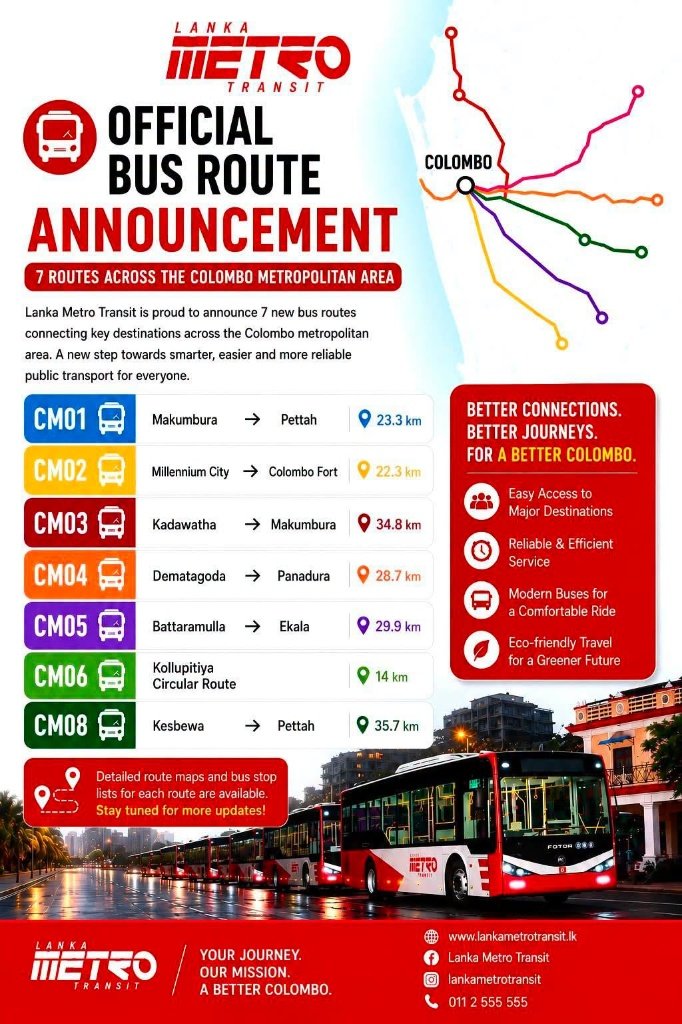
The announcement identifies seven services, ranging from a 14-kilometre circular route to a 35.7-kilometre connection between Kesbewa and Pettah.
Route
Connection
Distance
CM01
Makumbura → Pettah
23.3 km
CM02
Millennium City → Colombo Fort
22.3 km
CM03
Kadawatha → Makumbura
34.8 km
CM04
Dematagoda → Panadura
28.7 km
CM05
Battaramulla → Ekala
29.9 km
CM06
Kollupitiya Circular Route
14 km
CM08
Kesbewa → Pettah
35.7 km
CM01: Makumbura to Pettah
The CM01 route is listed as a 23.3-kilometre connection between Makumbura and Pettah.
This corridor has the potential to serve passengers transferring from longer-distance services at Makumbura before continuing towards the commercial heart of Colombo. Pettah is one of the country’s busiest trading and public transport districts, making it a significant destination for workers, shoppers and travellers.
A direct service could simplify the journey for passengers who would otherwise need to change buses or use several forms of transport.
CM02: Millennium City to Colombo Fort
The 22.3-kilometre CM02 service is planned to operate between Millennium City and Colombo Fort.
Colombo Fort remains a pivotal destination for office employees, railway passengers, tourists and people accessing financial or government services. A direct connection from Millennium City could offer residents a more straightforward route into the central business district.
The effectiveness of this service will depend heavily on its operating frequency, travel time and integration with other transport services at Colombo Fort.
CM03: Kadawatha to Makumbura
At 34.8 kilometres, CM03 is one of the longest routes in the announced network.
Its proposed connection between Kadawatha and Makumbura is particularly noteworthy because it links two important suburban transport areas without requiring passengers to travel through central Colombo. This type of peripheral connection can help create a more polycentric transport network, where movement does not depend exclusively on the city centre.
Such routes may also reduce the burden on already congested central corridors.
CM04: Dematagoda to Panadura
The CM04 route is listed as a 28.7-kilometre service between Dematagoda and Panadura.
This connection could support passengers travelling between Colombo’s northern-central urban areas and the southern coastal corridor. Panadura is a major residential and commercial centre, while Dematagoda provides access to densely populated communities and established transport links.
A dependable direct service could be valuable for workers, students and regular interurban passengers.
CM05: Battaramulla to Ekala
The proposed CM05 service covers 29.9 kilometres between Battaramulla and Ekala.
This is a strategically interesting cross-metropolitan route. Battaramulla is associated with administrative institutions, offices and expanding residential zones, while Ekala is connected to industrial, commercial and residential activity closer to the Katunayake corridor.
A direct bus service between these locations could improve access to employment and reduce the need for circuitous journeys through Colombo.
CM06: Kollupitiya Circular Route
At 14 kilometres, CM06 is the shortest route listed in the announcement.
Unlike the other services, it is described as a circular route. Circular services can be useful in dense urban districts because they connect multiple destinations within a defined area and allow passengers to complete shorter journeys without travelling to a central terminal.
The route’s practical value will depend on the specific roads, stops and landmarks included in the final map.
CM08: Kesbewa to Pettah
CM08 is the longest service in the announced network, covering 35.7 kilometres between Kesbewa and Pettah.
Kesbewa and its surrounding areas have experienced substantial residential and commercial growth. A direct connection to Pettah could serve commuters, traders and passengers transferring to other bus or rail services.
Because of its length, operational consistency will be especially important. Passengers will need clear information about expected journey times, service intervals and intermediate stops.
It is also worth noting that the published list moves from CM06 to CM08, with no CM07 shown. Passengers should check official updates to determine whether CM07 is reserved for a future route, omitted from the announcement or subject to separate publication.
Why the Expansion Matters
Better Access to Major Destinations
Public transport is fundamentally an accessibility system.
Its value is not measured solely by the number of vehicles in operation, but by the opportunities passengers can reach. A well-connected bus network allows people to access jobs, schools, hospitals, commercial centres and government services without relying entirely on private transport.
The proposed routes link several high-demand destinations with growing residential areas. This could be particularly beneficial for passengers who do not own private vehicles or who currently depend on multiple bus connections.
Improved access can also support social inclusion. When transport is affordable and comprehensible, more people can participate in economic and civic life.
More Efficient Daily Journeys
One of the most persistent challenges in metropolitan travel is the need to make unnecessary transfers.
Changing buses adds uncertainty. Passengers must account for waiting times, route availability and the possibility of missing a connection. Even when the total distance is relatively modest, a fragmented journey can become lengthy and exhausting.
Direct routes between major locations may reduce this friction.
The Kadawatha–Makumbura and Battaramulla–Ekala connections are especially significant because they appear to facilitate cross-suburban travel. These services may allow passengers to bypass central Colombo when their destination lies elsewhere in the metropolitan region.
That is an important planning principle. A mature transport network should not force every journey through the same congested centre.
Improved Passenger Experience
The announcement promotes modern buses, reliable service and a more comfortable journey.
These qualities matter.
Passengers are more likely to choose public transport when services are punctual, clean, safe and easy to understand. Vehicle quality is important, but operational discipline is equally consequential. A modern bus cannot compensate for irregular departure times, unclear stops or inadequate passenger information.
A strong passenger experience therefore requires several interconnected elements:
Consistent service frequencies
Clearly identified bus stops
Accurate route information
Safe boarding and alighting arrangements
Accessible customer support
Well-maintained vehicles
Transparent fare structures
Consideration for elderly passengers and people with disabilities
Reliability is often the decisive factor. Passengers need confidence that a bus will arrive within a reasonable and predictable period.
Support for Sustainable Urban Mobility
An expanded public transport network can contribute to a more sustainable metropolitan transport system.
When reliable buses are available, some commuters may choose to leave private vehicles at home. This can help reduce road congestion, fuel consumption and the demand for parking in densely developed areas.
The environmental effect of a transport network, however, depends on more than the number of buses deployed. Vehicle technology, fuel efficiency, occupancy rates, maintenance standards and route planning all influence the final outcome.
A well-utilised bus can carry many passengers while occupying considerably less road space per person than a line of private cars. For that reason, high-capacity public transport remains an essential component of sustainable urban development.
The broader objective should be modal transition: encouraging a gradual shift from individual vehicle use towards efficient shared transport.
An Investment in Greater Colombo’s Connectivity
This route expansion represents more than the introduction of new buses. It is an investment in urban mobility, economic accessibility and the future connectivity of Greater Colombo.
Transport infrastructure has a direct relationship with productivity.
When employees can reach workplaces reliably, businesses benefit from a more accessible labour market. When students can travel to educational institutions without excessive delays, academic participation becomes easier. When patients can reach healthcare facilities more efficiently, transport becomes part of the social support system.
Public transport also shapes the geography of opportunity. Communities with strong transport links are better positioned to attract investment, support local commerce and connect residents with services beyond their immediate neighbourhoods.
For these reasons, the success of the new routes should not be assessed only by the number of passengers carried during the first few weeks. Longer-term evaluation should consider journey-time reductions, service reliability, passenger satisfaction, affordability and the degree to which the routes reduce dependence on multiple transfers.
Integration Will Determine Long-Term Success
Introducing a route is only the beginning. Integration determines whether it becomes genuinely useful.
The new services should ideally coordinate with existing bus terminals, railway stations and other public transport networks. Passengers arriving at Makumbura, Pettah or Colombo Fort may need to continue their journeys using another mode of transport.
Poorly coordinated services can create bottlenecks. Well-integrated services create continuity.
Information integration is equally important. Route numbers, destinations, stopping patterns and departure times should be presented consistently across buses, terminals, websites and social media platforms. Digital journey-planning tools can further improve usability, particularly for passengers unfamiliar with a route.
Clear wayfinding reduces cognitive burden. It allows passengers to make decisions quickly and travel with greater confidence.
Passenger Information to Confirm Before Travelling
The announcement provides an overview of the routes, but passengers should obtain complete operational information before planning a journey.
Official Commencement Dates
An announced route may not begin operating immediately. Passengers should confirm the official launch date for each service through Lanka Metro Transit’s verified channels.
Some routes may also be introduced in phases rather than commencing simultaneously.
Operating Hours and Service Frequency
The usefulness of a route depends on when and how often it operates.
Passengers should check:
First and final departure times
Peak-hour frequencies
Off-peak service intervals
Weekend and public-holiday schedules
Any limited-stop or express operating patterns
A route may connect two important destinations, but infrequent service can significantly reduce its practical value.
Complete Bus-Stop Lists
The published endpoints do not reveal every location served along the way.
Detailed stop lists will help passengers determine whether a service passes close to their home, workplace or intended destination. They will also show where passengers can transfer to other routes.
Fare Structures
Passengers should verify the applicable fares before travelling.
Important questions include whether fares will be distance-based, whether cashless payment options will be available and whether concessionary arrangements apply to students, senior citizens or other eligible groups.
Route Maps and Interchange Points
A full map should identify the roads used, intermediate stops, terminal locations and interchange opportunities.
This information is particularly important for longer services such as CM03 and CM08. Passengers need to know not only where a route begins and ends, but how it travels between those points.
Accessibility and Passenger Services
Travellers should also look for information about low-floor access, priority seating, wheelchair accommodation, luggage policies and customer-assistance services.
Accessibility should be treated as a fundamental design consideration rather than an ancillary feature.
The Need for Transparent Service Updates
The announcement states that detailed route maps and bus-stop lists will be made available through future updates.
Transparent communication will be crucial during the implementation period. New routes often require adjustments after launch as operators evaluate traffic conditions, passenger demand and journey times.
Service changes should be communicated promptly and consistently.
Passengers benefit when updates include precise information rather than general statements. For example, a notification should clearly identify the affected route, date, operating period and alternative arrangements.
Accurate communication builds public confidence. Ambiguity erodes it.
A Potential Turning Point for Metropolitan Travel
The proposed seven-route network has the potential to strengthen connections between Colombo’s urban centre and its rapidly developing suburban communities.
Its ultimate impact will depend on execution.
Frequent buses, realistic timetables, competent maintenance and clear passenger information will determine whether the services become trusted components of daily life. Route planning must also remain responsive to actual passenger demand rather than relying solely on initial projections.
The announcement is nevertheless significant. It signals an effort to create a broader metropolitan transport framework—one that recognises the changing geography of Colombo and the need for direct connections beyond traditional city-bound commuting patterns.
For passengers, the most meaningful outcome would be simple: shorter waits, fewer transfers and more predictable journeys.
Which Route Could Transform Your Daily Commute?
Would the Makumbura–Pettah connection simplify your journey into the city? Could the Kadawatha–Makumbura service eliminate an inconvenient transfer? Or would the Kesbewa–Pettah route provide a more direct path to work, education or commercial services?
The value of each route will be experienced differently across the metropolitan area. Public feedback may therefore play an important role in refining timetables, identifying high-demand stops and improving future services.
🚌
Plan Your Colombo Metro Journey
Visit the Lanka Metro SmartMetro information page and follow the operator’s verified communication channels for confirmed launch dates, schedules, route maps, bus-stop lists, fares and the latest service updates.
Seven new routes could mean more than additional travel options. They could represent stronger connections, greater accessibility and a more integrated future for public transport in Colombo.
Classify Lanka Directory is a place to popularize your Business and generate leads in Sri Lanka. Get reviews and grow business reputation online. Your company profile can include contacts and description, products, photo gallery and your business location on the map.